Swing trades sit between our day trades and our long term holds. They usually last from a few days to a couple of months, long and short. The goal is to catch a move the market hasn't priced in yet and get out once it has.
Every swing trade needs both layers of our framework. The first is a dislocation: the crowd is scared, bored or euphoric in a way that has pushed the price somewhere it shouldn't be. The second is a concrete reason the crowd is wrong. A stock that's down isn't enough by itself, and neither is a great thesis on a stock that already reflects it.
How We Run a Swing Trade
Find what nobody is watching. Our best swing trades have come from parts of the market that were being ignored, or from moves driven by fear we thought was temporary.
Scale in. We build positions in pieces, so we're not betting the whole position on a single entry price.
Know what would prove us wrong. Before we enter we decide what would break the thesis and how much we are willing to lose.
Scale out into strength. As the thesis plays out we trim at levels on the way, instead of trying to sell the exact top.
Real Trades
In early 2026, everyone in the AI trade was focused on NVIDIA, AMD and Broadcom. Memory was an afterthought, and SanDisk had traded sideways between $480 and $580 for months. The supply picture told a different story: hyperscalers were locking in memory contracts, competitors were sold out, and SanDisk was priced as if none of that was happening.
We entered around $565 on February 5 and scaled out as the thesis played out, with the last shares sold at $822 on April 9. That was about $200 a share and over $20,000 in realized profit. One member made $800 on the same trade, which covers 16 months of membership.
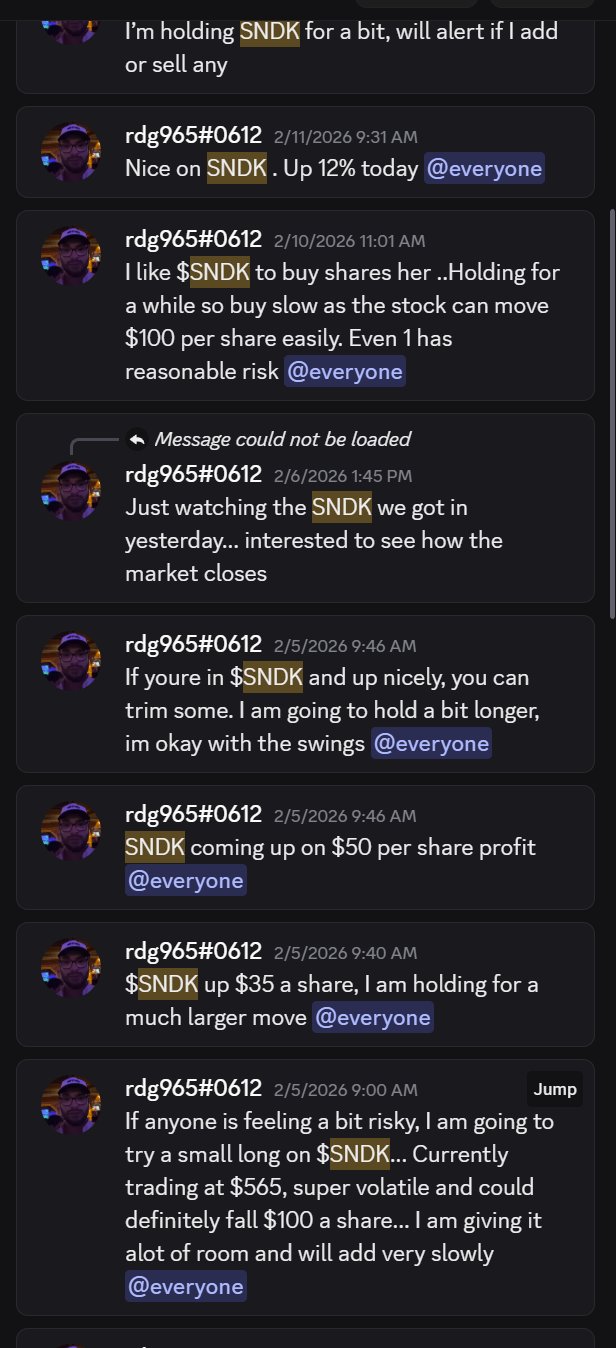
SNDK in the Discord: the $565 entry on February 5, 2026 and the first updates.
When fear of war with Iran sent oil from $85 to $117 in a matter of days, we saw a war premium that was likely to come out once negotiations started. We scaled the short from 30 to 115 shares over five days and closed it for $22.50 a share as oil came back down.
Micron's run from $90 to $818 ended with its most aggressive days. We started a small short on May 8, 2026, added into the spikes, and trimmed at every level from $710 down to $673 by May 18. About $80 a share for us, and $100 to $120 a share for members who managed it on their own.
Read the MU case study →Where the Profits Go
Swing trade profits don't sit in cash. They flow into our long term conviction positions. When we closed MU, the profit went straight into more INGN shares. Over time, the short term trades fund the long term holdings, and that recycling is a big part of how the portfolio compounds.
Common Questions
How long do you hold a swing trade?
Usually a few days to a couple of months. USO lasted five days, MU about ten, and SNDK about two months.
Do you swing trade both long and short?
Yes. SNDK was a long, while USO and MU were shorts. The framework is the same in both directions.
Do you use stop losses?
We decide the maximum risk before entering and size the position around it. We usually manage that by scaling in and trimming rather than a single hard stop, and every alert includes the plan.
How will I know when to sell?
Members get the exits in real time, including each trim. You can follow them exactly or manage your own exits, and several members do.
Sweet Spot Trading is for educational and informational purposes only. Trade ideas are opinions, not financial advice, and past results do not guarantee future returns. Trading, and especially options and short selling, involves substantial risk of loss.