Our day trades are built on one idea. When a large stock falls hard and fast on fear that has nothing to do with the company, the selling eventually runs out of steam, and it usually stops abruptly. We compare it to a sprinter running all out. The faster they go, the more certain it is they'll have to stop and catch their breath. That pause is the trade.
We are not predicting a reversal or a new trend. We're trying to capture the reflexive bounce, usually $2 to $6 a share, and then get out before a day trade turns into something else.
What a Setup Needs
All of these have to be true, not just some of them.
A large cap, liquid name. Apple, Palantir, Meta, Qualcomm. Names with deep liquidity and institutional buyers waiting at known levels. No penny stocks or low float names.
A macro driven move. If Apple is down 5% because earnings were bad, that's a business problem and we stay away. If it's down 5% on a tariff headline that doesn't change its business, that's an emotional reaction we can trade.
Dramatic candles. A slow drift into a level doesn't count. We want consecutive bars getting bigger and faster, with volume surging. A stock that slides to $245 over three days still has sellers left. A stock that crashes to $245 in two hours usually doesn't.
If anything is missing, we skip it. Going a week without a day trade is normal for us.
Entries and Exits
We scale in. If the level is $245 and the stock is falling through $247, we might start a small position just above the level, add if it hits $245, and add the last piece if it wicks below. Never the whole position at one price.
Exits are the part most people get wrong. Once the bounce gives us a few dollars, we sell. We don't hold for $5 when the setup was built for $2, and we don't let a day trade become a swing trade because we hope it keeps going.
Real Trades
On April 7, 2026, Apple was down 5% on Iran headlines with consecutive red candles heading into $245, a level where institutional buyers had stepped in before. We called the $245 support in the Discord at 10:08 AM, bought the exhaustion, and trimmed 75% of the position on the bounce. About $2 a share in 30 minutes.
Three days later, Palantir dropped from $131 to $122.68 on macro fear. We waited for it to break below $125 support, bought near the $122 low, and sold everything at $127.73. In and out in 30 minutes. One member who took the trade before going back to his day job called it "nice lunch money."
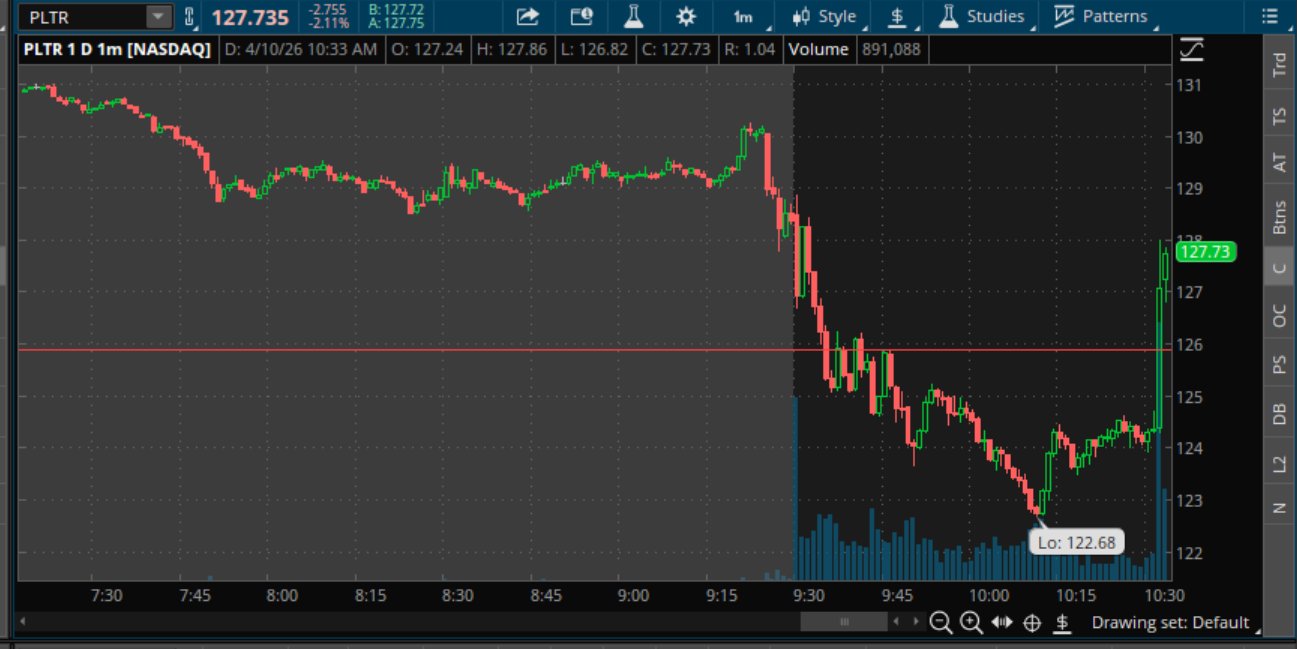
PLTR on April 10, 2026. Crashed from $131 to $122.68 on macro fear. We bought the exhaustion and sold at $127.73.
The framework works in reverse too. On May 7, 2026, Qualcomm ripped from $190 to $223.66 in 90 minutes with no company news behind it. At 11:43 AM we posted a small short at $222, flagged it as high risk, told members not to oversize, and named $235 as the level where the idea would be wrong. We trimmed at 11:48, trimmed again at 11:50, and were all out at 11:51 with about $6 a share.
See the full eight minute timeline →Why Risk Comes First in Every Alert
Look at the QCOM alert again. The first things members read were "SMALL," "high risk," and the price where the trade fails. Day trades move fast, and most of the damage traders do to themselves comes from sizing too big on a setup that looked obvious. We'd rather someone skip a trade than take it at a size that hurts.
Common Questions
Do I need to watch the screen all day?
No, but day trades move quickly. The QCOM trade lasted eight minutes from entry to exit. If you can't act within a few minutes of an alert, it is fine to skip day trades and focus on our swing and long term positions.
What stocks do you day trade?
Large, liquid names only, such as Apple, Palantir, Meta and Qualcomm. We avoid small caps and low float stocks, where moves are harder to read and exits can be difficult.
How much do you make per day trade?
Usually $2 to $6 a share. The goal is a quick, repeatable gain, not a home run. Profits from these trades often get recycled into our long term positions.
How often do you day trade?
Only when every condition lines up. Some weeks have a few day trades and some have none.
Sweet Spot Trading is for educational and informational purposes only. Trade ideas are opinions, not financial advice, and past results do not guarantee future returns. Trading, and especially options and short selling, involves substantial risk of loss.