CAR (Avis Budget Group) went from $75 to $847 in six weeks. 53% of the float was sold short. It was the most heavily shorted stock in the entire Russell 1000. And we shorted it.
Not because we thought the chart looked overextended. Not because RSI said overbought. We shorted it because we understood the people making the decisions, and those people had no choice but to sell shares into the rally.
The Thesis: Fiduciary Duty
Avis had $25 billion in debt. Nearly a billion dollars in net losses. Financial strength rated 2 out of 10. Six months earlier, this was a company staring down a potential debt crisis at $75 per share.
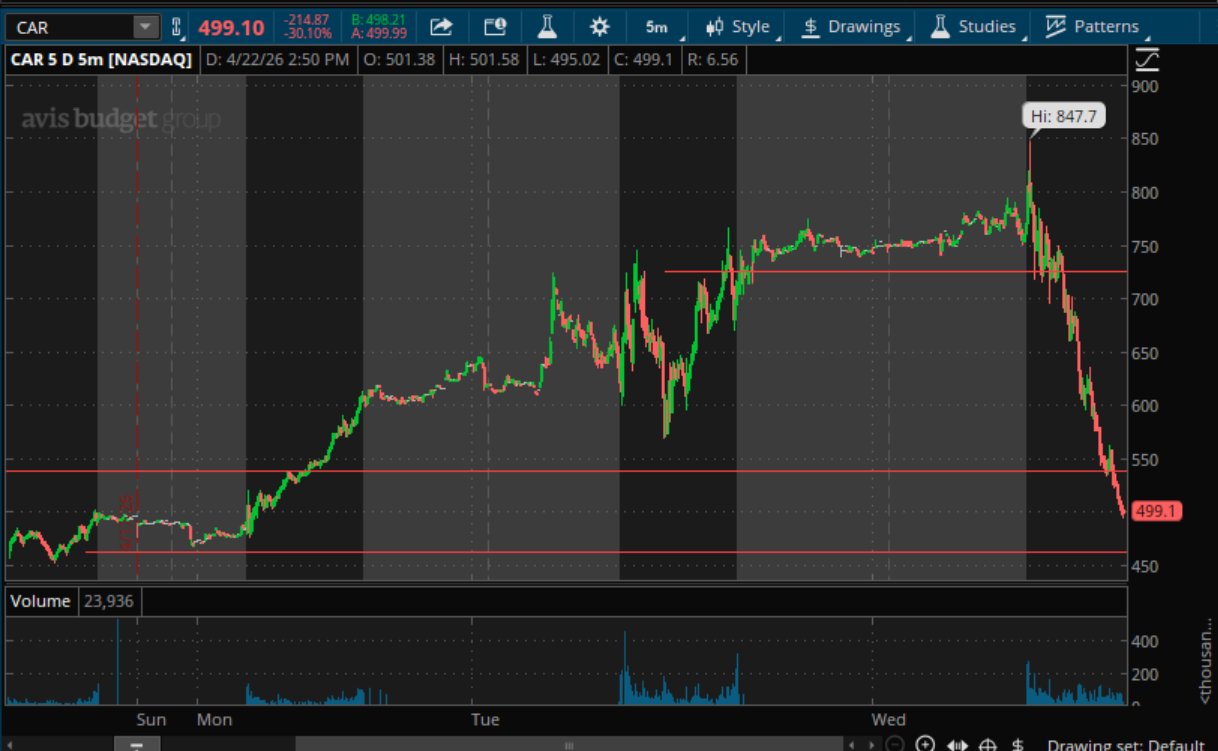
CAR (Avis Budget): $847 to $499 in a single session. The 41% intraday crash after the squeeze broke.
Then TSA staffing problems disrupted airports across the country, pushing travelers toward rental cars. Revenue got a temporary bump. And the 53% short interest turned a modest rally into a full-blown squeeze. Shorts covering forced the stock higher, which forced more shorts to cover, which pushed it higher still.
But here's what the squeeze traders missed: Avis had an At-the-Market offering in place. Five million shares the company could sell directly into the open market at prevailing prices. At $500+ per share, those five million shares represent over $2.5 billion in cash, enough to restructure the entire balance sheet.
If you're sitting in that boardroom with $25 billion in debt and your stock just went up 800%, you have a fiduciary obligation to sell those shares. If they DON'T dilute aggressively at these prices, they should be investigated. That's not a trading opinion. That's corporate governance.
The squeeze creates the price. The ATM offering creates the ceiling. Eventually, the company selling shares into the rally overwhelms the short-covering demand. That's the thesis. Not a chart pattern. A structural inevitability.
The Entry: Start Small
We entered with 5 shares. Five. On a stock trading over $500. That's roughly $2,500 of exposure on a seven-figure portfolio. We told the discord: "Gotta be small, could squeeze much higher."
The next day we tried to add more. Schwab's automated lending system rejected the order. Couldn't locate a single additional share to borrow. When the broker's system can't find ONE share, that tells you how crowded the short side is.
Eventually we located 4 more shares at $800 the following morning. Total position: 22 shares, approximately $677 average. Maximum risk defined at the outset: $6,000-7,000. About half a percent of the portfolio. If this thing squeezed to $1,250, we'd take a manageable loss and move on.
The Squeeze: $847
It hit $847 the morning after we added. Twenty-two shares short, watching the stock trade $170 above our average. The unrealized loss was approaching $4,000.
Here's what we told the discord: "I really saw the possibility that this thing was going to $1,250, so I'm trimming in case that does happen and I can reload higher."
That's the key sentence. We didn't panic. We didn't cover everything at the worst price. We acknowledged the risk (yes, this could go much higher) and we adjusted. Trimmed exposure to reduce pain if the squeeze continued, while keeping enough shares to profit if it reversed.
Rather small win than big loss. That's not just a philosophy. It's a survival mechanism.
The Collapse: $847 to $499
Then it broke. $847 to $499 in a single session. A 41% intraday crash. The sprinter hit the wall at full speed.
We trimmed the entire way down. Three shares at $616. One at $585. More through the crash. All out at $499. Approximately $3,000 total profit on a trade where we risked less than $7,000 and survived a $170/share move against us.
Was $3,000 the maximum we could have made? No. If we'd held all 22 shares from $677 to $499, that's $3,916. But if we'd held all 22 shares and it squeezed to $1,000 instead of crashing, we'd have been down $7,000. The trimming reduced our best case AND our worst case. That's the tradeoff we always take.
What the Discord Learned
One of our members asked during the trade: "How does shorting work? Why can't we short?" He'd never shorted a stock before. We broke it down with a simple analogy:
Imagine you give a friend an ounce of gold for safekeeping while you're on vacation. Your friend thinks gold is going down, so he sells your ounce at the market price of $1,000. You come back from vacation. He goes to the store and buys back an ounce of gold at $900. Returns it to you. You still have your gold. He has $100 profit.
That member went from "what is short selling" to watching us navigate a historic squeeze in real time over the course of two days. He'll never forget how it works because he learned it while real money was on the line.
That's the product. Not alerts. Education through live fire.
The Lesson
The CAR trade wasn't about finding the perfect entry or timing the exact top. It was about three things:
First, understanding the decision-maker. The Avis board HAD to dilute. That structural reality was more powerful than any squeeze mechanics.
Second, sizing for survival. Twenty-two shares, not two hundred. Maximum loss defined before entry. Small enough to hold through the squeeze, large enough to matter when the thesis played out.
Third, trimming into the move. Take pieces off on the way down instead of trying to call the bottom. Same thing we do on every trade: USO, SNDK, all of them. Progressive exits, never all at once.
$3,000 profit. $7,000 max risk. One lesson in short selling that a member will carry for the rest of his trading career. Some weeks are about the P&L. This one was about the education.