On April 8th, the market was panicking about tariffs. Trump threatened 50% duties on any nation supplying weapons to Iran. The Nasdaq dropped. META fell to $600.
At the same time, buried beneath the tariff headlines, Alexander Wang, CEO of Scale AI and head of Meta's new Superintelligence Labs, tweeted a thread about Muse Spark. Meta's first model from their newly rebuilt AI stack. A natively multimodal reasoning model that beat GPT 5.4 and Gemini on visual understanding, health reasoning, and real-world comprehension.
We saw the tweet. We understood what it meant. We bought a $600 call expiring that day for $2.25.
Ten minutes later, we sold it for $12.80. A 469% return.
This Wasn't a Dislocation Trade
Our typical framework requires two layers: emotional dislocation creating a mispriced entry, plus a fundamental thesis explaining why the dislocation is wrong. This trade had both, but the catalyst was different from anything we'd done before.
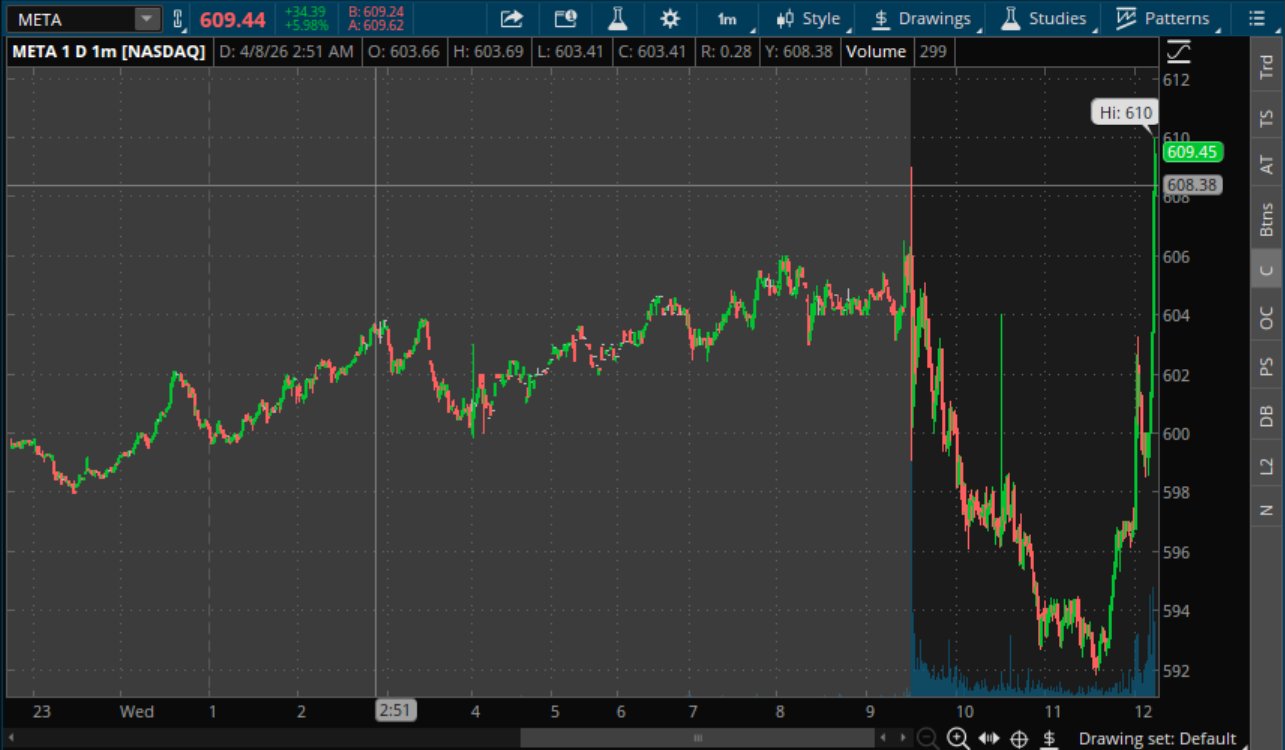
META on April 8, 2026. The spike on the right is the market digesting Muse Spark: $592 to $627 in one session.
The dislocation was the tariff tweet pushing META to $600. But we didn't buy because "META is oversold." We bought because we'd already read the Muse Spark announcement and understood that the market hadn't priced it in yet. The tariff panic was creating a cheaper entry on a stock that was about to rip on AI news.
The edge wasn't technical. It wasn't fundamental analysis. It was information processing speed. We saw a tweet, understood its implications for Meta's business (better ad targeting through visual AI, Instagram Shop powered by multimodal reasoning, Ray-Ban glasses with health capabilities, WhatsApp with an AI brain) and acted before the market connected the dots.
What Muse Spark Actually Means
The market has punished Meta for years over AI spending. The narrative was simple: Zuckerberg is burning $180 billion on AI infrastructure with nothing to show for it.
Muse Spark killed that narrative in one blog post. Meta rebuilt their entire AI stack from scratch and achieved the same capability with over 10x less compute than their previous models. They're now competitive with the best reasoning models on earth. In some categories, they're the best.
But here's what matters for the stock: Meta's AI doesn't need to win at coding benchmarks or math competitions. It needs to win at understanding what people are looking at and why they want to buy it. Visual understanding. Health reasoning. Real-world comprehension. Commerce. Those are the categories where Muse Spark leads, and those are the categories that directly improve Meta's core business.
Better visual AI means better ad targeting means higher ROAS means advertisers spend more. That's a direct line from a benchmark score to revenue growth. No other AI company has that translation mechanism at Meta's scale: 3.9 billion monthly active users.
Why We Took the Profit
The contract went from $2.25 to $12.80 where we sold. By end of day it was over $27. We left another $1,500 on the table.
Here's why we don't care: the call expired that day. Time decay was working against us every minute. If Trump tweeted another tariff threat at 2pm and META dropped back to $600, that call goes to zero. We'd have turned a $1,050 win into a total loss.
We took the $1,050 in 10 minutes and let the 354 shares ride the wave with no expiration risk. The shares are the position. The call was the bonus. By end of day META was at $627, and the shares gained more than the call ever would have been worth.
Gotta take that profit. The next Sweet Spot is always coming.
The Real Edge
Most trading discords would tell you this trade was about "buying the dip on META." It wasn't. A thousand traders bought the dip on META that morning. Most of them bought because the stock was down and they hoped it would bounce.
We bought because we'd already processed information that the market hadn't digested yet. We understood that a superintelligence announcement changes how Wall Street values Meta's entire AI investment. We understood that the $180 billion in capex just produced something competitive with the best in the world at 10x the efficiency. We understood that health AI plus Ray-Bans plus Instagram Shop plus 3.9 billion users equals a re-rating, not a bounce.
The tweet was public. Anyone could have seen it. The edge was understanding what it meant and acting before the crowd connected it to the stock price. That's not insider information. That's homework.
469% in ten minutes. Not because of an indicator. Because we read the right tweet at the right time and understood what it meant for a business we already knew inside and out.