Think of a sprinter running a 400 or 800 meter race all out. At full speed, they cannot maintain that pace. It's physically impossible. The harder they sprint, the more certain the stop is. And the stop isn't gradual. They hit a wall. Their body forces them to decelerate rapidly. The energy is spent.
That's exactly what we're trading. Not the direction. Not the level. The exhaustion of velocity.
What This Looks Like on a Chart
A large-cap stock drops 4-5% in a single morning session on macro fear, not company-specific news. On the 15-minute chart, you see consecutive red candles getting bigger and faster. The selling is accelerating. Each bar is more aggressive than the last. The stock is in a full sprint downhill.
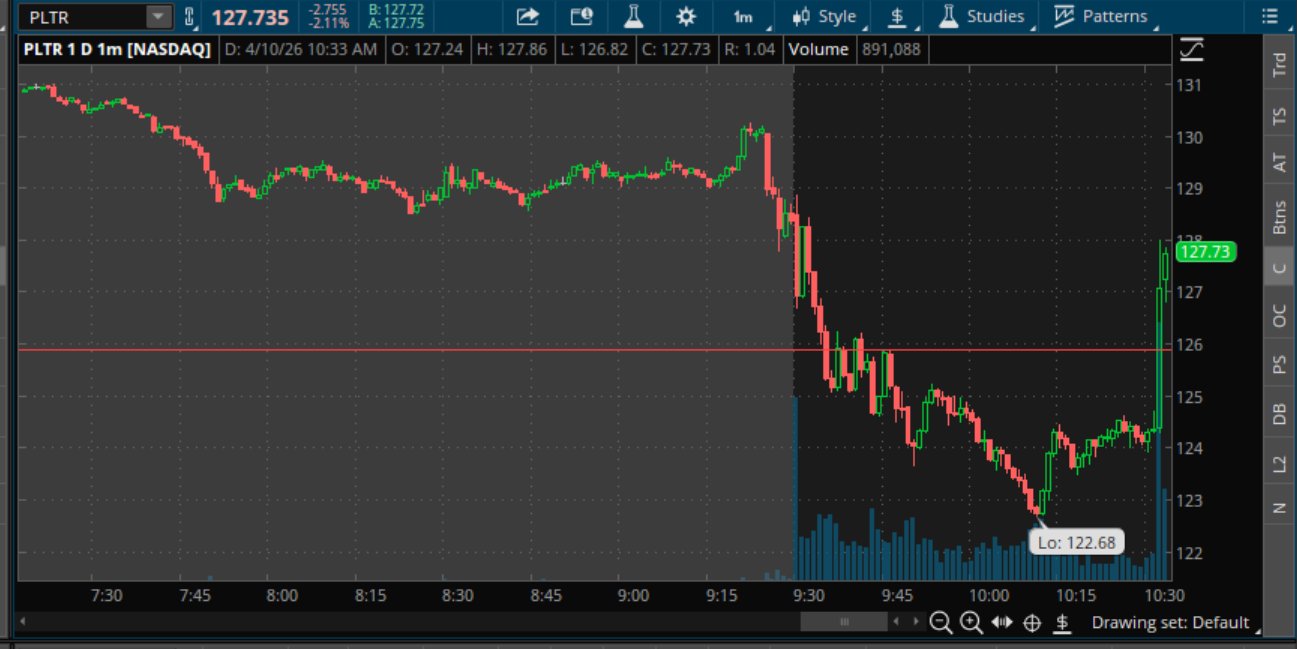
PLTR on April 10, 2026. Crashed from $131 to $122.68 on macro fear. We bought the exhaustion, sold at $127.73. In and out in 30 minutes.
It approaches a known support level: a price where the stock has previously bounced or consolidated. But here's the key distinction that separates us from every other trader watching that same level: we don't buy support. We buy exhaustion AT support.
A stock slowly drifting to $245 over three days is not the same as a stock crashing to $245 in two hours. Same price. Completely different energy. The slow drift has more to give. The sellers aren't tired yet. The sprint is done. The sellers have emptied the clip.
The Entry
We enter when we see the velocity peak. The candles are at their biggest, the volume is at its heaviest, and the selling feels like it will never stop. That feeling, that "this is going straight to zero" feeling, is the signal. The sprinter is at maximum speed. The wall is next.
We start small. If the level is $245 and the stock is at $247, falling fast, we might front-run the level slightly with a small position. Then add more if it actually hits $245. Then add the final piece if it undercuts to $244 on a wick. Never all-in at one price.
The Exit
This is where discipline matters most. We're not betting the sprinter turns around and runs a marathon in the other direction. We're betting they stop, bend over, and catch their breath for a minute. That minute is our $2/share. Then we leave.
Take the $2 and move on. Don't turn a day trade into a swing trade. Don't hold hoping for $5. The reflexive bounce is the trade. It's mechanical, predictable, and repeatable. The sprinter catches their breath, the stock bounces $2, we sell and wait for the next setup.
What Disqualifies a Setup
Not every selloff is a sprint. Here's what we need to see, all of it, not some of it:
The stock must be a large-cap quality name. We're not playing this with penny stocks or low-float names. Apple, Palantir, Meta: names with deep liquidity and institutional support waiting at known levels.
The selloff must be macro-driven, not company-specific. If Apple is down 5% because earnings were terrible, that's a fundamental problem. If Apple is down 5% because Trump tweeted about tariffs, that's an emotional reaction to something that doesn't affect Apple's business. We trade the second scenario, never the first.
The candles must be dramatic. Slow drift doesn't count. We need the waterfall: consecutive red bars getting bigger, volume surging, the chart looking like a cliff. That's how you know the sellers are sprinting and about to hit the wall.
If any of these are missing, we pass. No setup, no trade. Zero problem not placing a trade for seven days.
Why This Works
The win rate on this setup is high because we're not predicting direction, we're predicting physics. A sprinter at full speed WILL stop. It's not a guess. It's a certainty. The only question is where, and that's what the support level tells us.
The risk is low because we're buying at the moment of maximum pessimism, when everyone else is panic selling. Our cost basis is the lowest of the day. Even if the bounce is small, we're profitable. And if the trade doesn't work and support breaks, we're out quickly because we sized small.
One trade. One analogy. $2/share. Move on. That's the sprinter framework.