Options are a vehicle for us, not a strategy on their own. Every options trade starts with the same two layer framework we use everywhere else: an emotional dislocation in the market plus a reason we think the crowd is wrong. Options only come in when that thesis has a timeframe attached to it. If we think something happens today, this week, or over the next year, there is usually a contract that fits better than shares.
Most of the time we are buying calls or puts, which means the most we can lose is what we paid for the contract. That defined risk is the main reason we use them. We size options small, we take profits faster than we would on shares, and we treat the shares as the core position and the options as a bonus on top.
When We Reach for Options
A catalyst the market hasn't priced yet. When we see news that changes the story on a company we already know well, a short dated call can capture the move with very little capital at risk.
A known event with a predictable reaction. Speeches, deadlines and scheduled announcements can move the whole market. Puts or calls bought ahead of time let us express that view without putting a large amount of capital at risk overnight.
A conviction name on sale. When a company we plan to own for years drops on fear that has nothing to do with the business, long dated calls (LEAPS) give us leveraged exposure to the recovery.
Real Trades
On April 8, 2026, tariff headlines pushed META down to $600. At the same time, Meta's AI lead posted the Muse Spark announcement, which the market hadn't digested yet. We bought a $600 call expiring that day for $2.25 and sold it ten minutes later for $12.80, about $1,050 in profit on a single contract.
By the end of the day that contract was worth over $27. We left money on the table on purpose. The call expired that afternoon, time decay was working against us every minute, and one more tariff headline could have taken it to zero. Our 354 shares stayed in place and kept the upside.
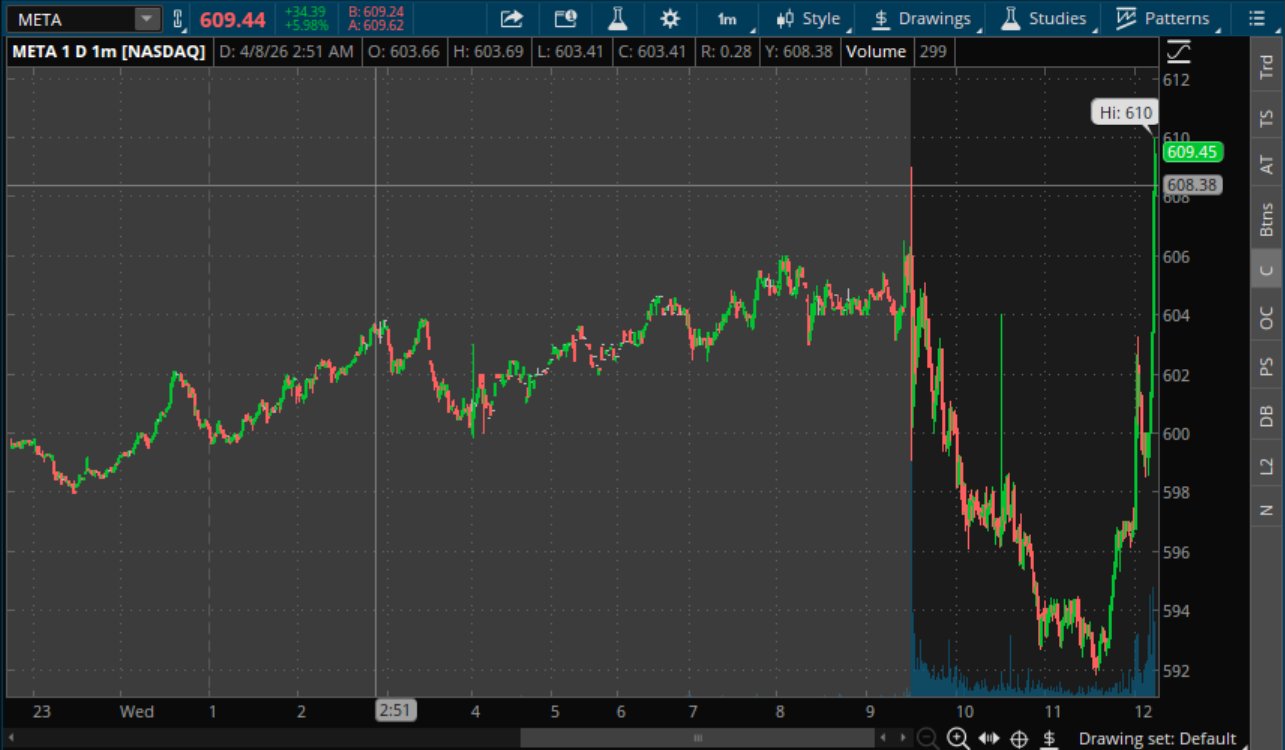
META on the morning of April 8, 2026, as the market started digesting the Muse Spark news. It closed the day at $627.
In April 2026 we bought QQQ puts ahead of a speech on Iran and held them overnight. The market sold off at the open and the puts went from $3.30 to $9.50, roughly three times what we paid. The thesis was about the reaction to an event we knew was coming, which is the kind of setup where a defined risk options trade makes more sense than shorting shares.
When META pulled back from $650 to $500 on broad market fear, nothing about the business had changed. We bought long dated calls across four accounts, captured the bounce for about $4,100, and rolled the profit into the long term share position.
How the two layer framework picks entries →We post losses too. Going into Meta's Q1 2026 earnings we held a small $670 strike call. The company beat on almost every number, but a capex guidance increase sent the stock down 12% after hours and the call expired worthless. That cost $2,400.
The thesis on the business was right, but the vehicle was wrong. Weekly options bought right before a known event carry inflated prices, and they only pay if the market reacts the way you expect to a single headline. We bought shares at $605 the next day instead, and we are much more careful about holding short dated options through earnings.
Why we bought more META at $605 →How We Manage Options Risk
Size for a total loss. Any option we buy can expire worthless, so every position is sized so that losing the full premium is a normal outcome, not a disaster.
Take profits quickly on short dated contracts. A same day or weekly option loses value every minute it doesn't move. When it pays, we usually sell instead of waiting for more.
Keep the core in shares. Options let us add to a view, but the long term position stays in stock, where there is no expiration date working against us.
Be careful around scheduled events. Contracts get more expensive right before earnings and big announcements. That premium has to be earned back before the trade makes money.
Common Questions
What kinds of options do you trade?
Mostly buying calls and puts. That ranges from contracts that expire the same day to LEAPS that run a year or more out. Buying options keeps the maximum loss limited to the premium paid.
How often do you post options trades?
Only when a setup has a clear catalyst and timeframe. Some months have several options trades and some have none. We do not trade options just to stay busy.
Are options a good place for beginners to start?
Options can go to zero quickly, so we suggest learning the framework on shares first. Every alert includes the reasoning, so newer members can follow along and see why an option was chosen over stock before trying it themselves.
Do you hold options through earnings?
Rarely, and our META earnings call in April is the reason. Implied volatility makes contracts expensive right before a report, and the stock can react to one line item instead of the overall results. We generally prefer shares through earnings.
Sweet Spot Trading is for educational and informational purposes only. Trade ideas are opinions, not financial advice, and past results do not guarantee future returns. Trading, and especially options and short selling, involves substantial risk of loss.