There's a medtech company trading on the Nasdaq that most fund managers have never heard of. It has $121 million in cash. Zero debt. $360 million in annual revenue growing mid-single digits. Seven consecutive earnings beats. A new CEO executing a turnaround. An activist hedge fund on the board. A freshly authorized $30 million share buyback that's already executing.
The market values the entire company at roughly $160 million.
Subtract the cash on the balance sheet and the market is pricing the operating business (the brand, the products, the patents, the revenue, the management team, the manufacturing, the distribution network, the customer relationships) at approximately $28 million.
Twenty-eight million dollars for a company generating $360 million in annual revenue.
We hold a significant position. Tens of thousands of shares. And we're still adding.
Why It's This Cheap
The easy answer is "the market is irrational." That's lazy. The market is rational about the things it pays attention to. The problem is that nobody is paying attention to this stock.
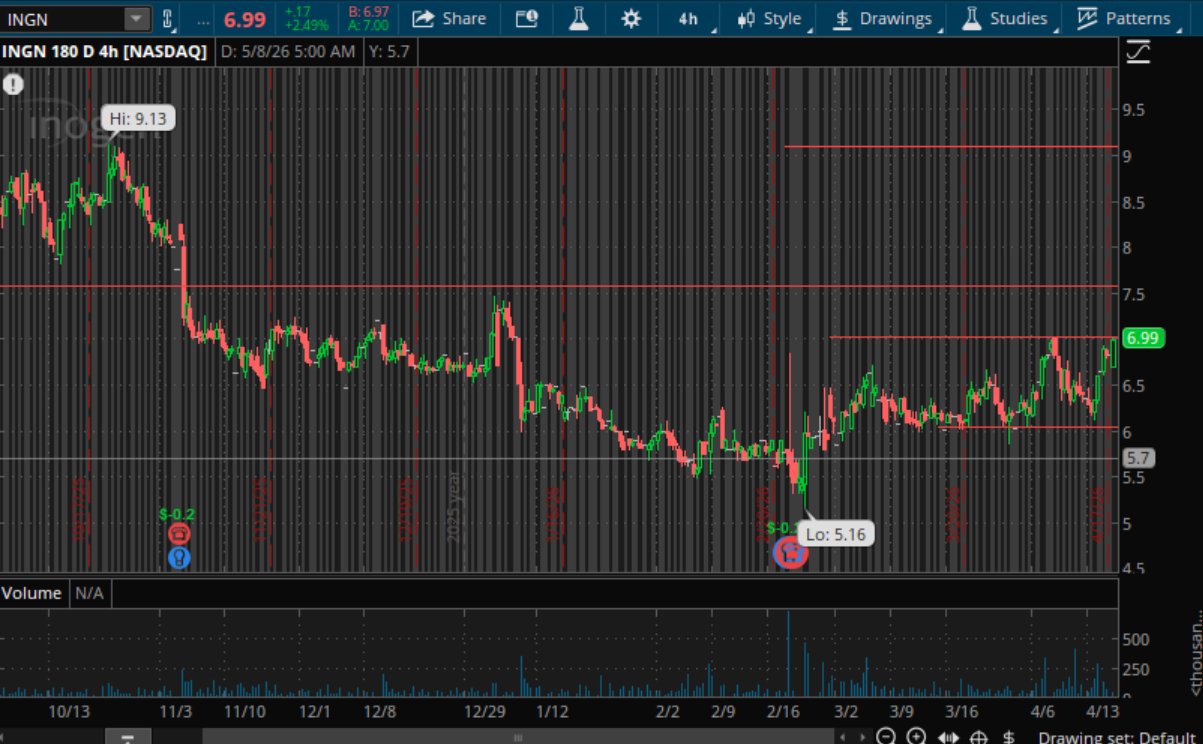
INGN 180-day chart. From $5.16 to $7.10, building higher lows since February. The red lines are hand-drawn support and resistance, no indicators.
The market cap is below $200 million, under the minimum threshold for most institutional funds. A mid-size fund can't build a position without moving the stock 20% because daily volume is only 150,000 shares. Zero major analyst coverage. No CNBC mentions. No Reddit threads. No viral moments.
It's not in AI. It's not in crypto. It's not in GLP-1 weight loss. It's a medical device company that makes portable oxygen concentrators for people with chronic respiratory conditions. Nobody at a cocktail party is going to ask you if you've heard about the latest developments in supplemental oxygen therapy.
But the most important reason it's cheap is the former CFO. For years, the company's financial results were communicated to Wall Street by someone who couldn't sell the story. Evasive on earnings calls. Low energy. Minimal guidance. Failed to articulate the vision. A family member who had never listened to an earnings call before immediately identified the problem after hearing one call.
The market can't be forward-looking on a stock it doesn't know exists. And a stock can't get discovered if the person responsible for telling the story can't tell it.
What Changed
Everything changed in the span of one week.
A new CFO was appointed, a 25-year MedTech veteran who previously ran a $3 billion segment at a major healthcare company. He's already spoken publicly and the difference from his predecessor is night and day. Articulate, confident, experienced in investor communication. The pipeline between the company and capital markets just got fixed.
An activist hedge fund with roughly $470 million in assets took a 4.9% stake and placed a board member, a former CEO of a publicly traded medical device company who previously ran a $3 billion respiratory care division. This fund's pattern at other investments is consistent: take a stake, get a board seat, then ADD to the position over subsequent quarters.
A new Chief Marketing Officer was hired from a leading diabetes technology company. A new VP of B2B Sales was hired from a competitor. The entire commercial leadership was upgraded in a coordinated "deliberate realignment."
And the $30 million share buyback is already executing. We've watched the tape: block prints of 50,000-80,000 shares appearing at the lows, volume spikes at levels where someone is systematically accumulating. This was confirmed at a recent investor conference: buybacks have begun.
Why It's Worth Multiples of the Current Price
The company isn't just a portable oxygen concentrator maker anymore. The product portfolio has expanded into stationary concentrators, CPAP masks for sleep apnea, airway clearance devices, and international distribution through a major Chinese partner. The addressable market has grown from approximately $400 million to over $3 billion.
At the current stock price, the company trades at 0.46x revenue. For context, medtech companies typically trade at 3-6x revenue. Even at 1x revenue, the most conservative valuation anyone could apply, the stock would be more than double the current price.
Analyst consensus from the few firms covering the stock is more than double the current price. The most bullish analyst target implies nearly triple. And we believe even those targets are too low given the expanded product portfolio and new leadership team.
The Frustration Is the Opportunity
Owning this stock is genuinely frustrating. The S&P will rip 3% on a relief rally and this stock finishes red. Every catalyst we've identified is real but the price action doesn't reflect it. Some weeks we watch the position bleed on microscopic volume while the fundamentals improve underneath.
But here's the thing about small-cap medtech stocks with no coverage: they don't gradually reprice. They're flat for months while catalysts accumulate, and then they move 20% in a week when someone with capital finally notices.
We've already seen this play out. The stock dropped to its lows on macro fears, we added aggressively, and within days it rallied 20% on the activist and CFO announcements. Then it pulled back again on nothing: low volume, no news, just the absence of buyers on a thin-float stock. We added again. And it rallied again.
The pattern is accumulation, frustration, accumulation, explosion. Repeat until the market cap reflects reality.
Early vs Wrong
There's an honest question we ask ourselves constantly: are we early or are we wrong?
Being early and being wrong look identical on the tape. The only way to tell the difference is tracking the fundamentals independently of the stock price. Is the business deteriorating? No. Revenue growing, earnings beating, cash stable, products launching, leadership upgrading. Is the balance sheet at risk? No. $121 million cash, zero debt, can operate for years without raising capital. Is there a competitive threat? The primary competitor is actually losing engineers to this company.
Every single indicator says the business is getting better while the stock gets cheaper. That's the definition of early, not wrong.
The upcoming earnings call will be the new CFO's first. The market will hear the new voice for the first time. The buyback activity will be disclosed in the quarterly filing. If the fundamentals deliver again (beat number eight) and the new CFO communicates it effectively, this could be the moment the forward-looking machine finally turns on for a stock it's been ignoring.
We're positioned. Significantly. Because when the market discovers what we already know, the repricing won't be gradual. It never is on small caps. It's sudden, violent, and rewarding for anyone who had the patience to accumulate while nobody was watching.
That patience is the price of admission. We've paid it. Now we wait.