Most of our shorts are not about valuation. Micron at under 5x forward earnings was not an obvious short on the numbers. We shorted it anyway, because the people buying at the top were not making a fundamental decision. When a stock runs for months and then accelerates even faster at the end, with volume spiking and the crowd that has no real thesis piling in, the move is usually close to running out of fuel.
We call this exit velocity. A sprinter at full speed can't hold that pace forever, and when they stop, they stop hard. We have now traded this pattern across silver, oil, Avis Budget, SanDisk, Intel and Micron. Different assets, same behavior.
How a Short Works
We use a simple example with members who have never shorted before. Say you give a friend an ounce of gold to hold while you're on vacation. He thinks gold is about to drop, so he sells your ounce for $1,000. When you get back, he buys an ounce for $900 and returns it to you. You have your gold back and he keeps the $100 difference.
Shorting a stock works the same way. Your broker lends you shares, you sell them, and you buy them back later. If the price fell, you profit. If it rose, you lose, and there is no ceiling on how high a stock can go. That last part is why everything below is built around position size.
Our Rules for Shorting
Start small. Euphoric stocks can always go higher than you expect. First entries are scout size.
Add into spikes, never all at once. We build the position as the stock pushes higher, so the average price improves if the run continues.
Define the maximum loss before the first share. On CAR we set it at $6,000 to $7,000, about half a percent of the portfolio, before entering.
Trim at every level on the way down. We don't try to call the bottom. Taking pieces off as the stock falls lowers the best case and the worst case at the same time, and we're fine with that tradeoff.
Real Trades
Micron went from $90 to $818 in twelve months. On May 8, 2026, with the stock up 15% in a single session, we started a small short and kept adding in small pieces over the next few days. Our average was $761. When it broke, we trimmed 10% at a time from $710 down to $673 and closed the rest.
That worked out to about $80 a share across the trims. Two members who learned the setup and managed it on their own made roughly $100 and $120 a share. We ran the same play on Intel at the same time and closed it for about $20 a share.
Read the full MU timeline →Avis Budget ran from $75 to $847 in six weeks with 53% of the float sold short, the most shorted stock in the Russell 1000. Our thesis was about the board. With $25 billion in debt and an at the market offering in place, management had every reason to sell new shares into the rally, which would eventually cap the price.
We started with 5 shares and built to 22 at about a $677 average. At one point Schwab couldn't locate a single additional share to borrow, and at the peak the stock traded $170 above our average. We trimmed some exposure in case it ran to $1,250, held the rest, and then watched it fall from $847 to $499 in one session. We trimmed all the way down for about $3,000 in profit on a trade where the maximum risk was capped under $7,000.
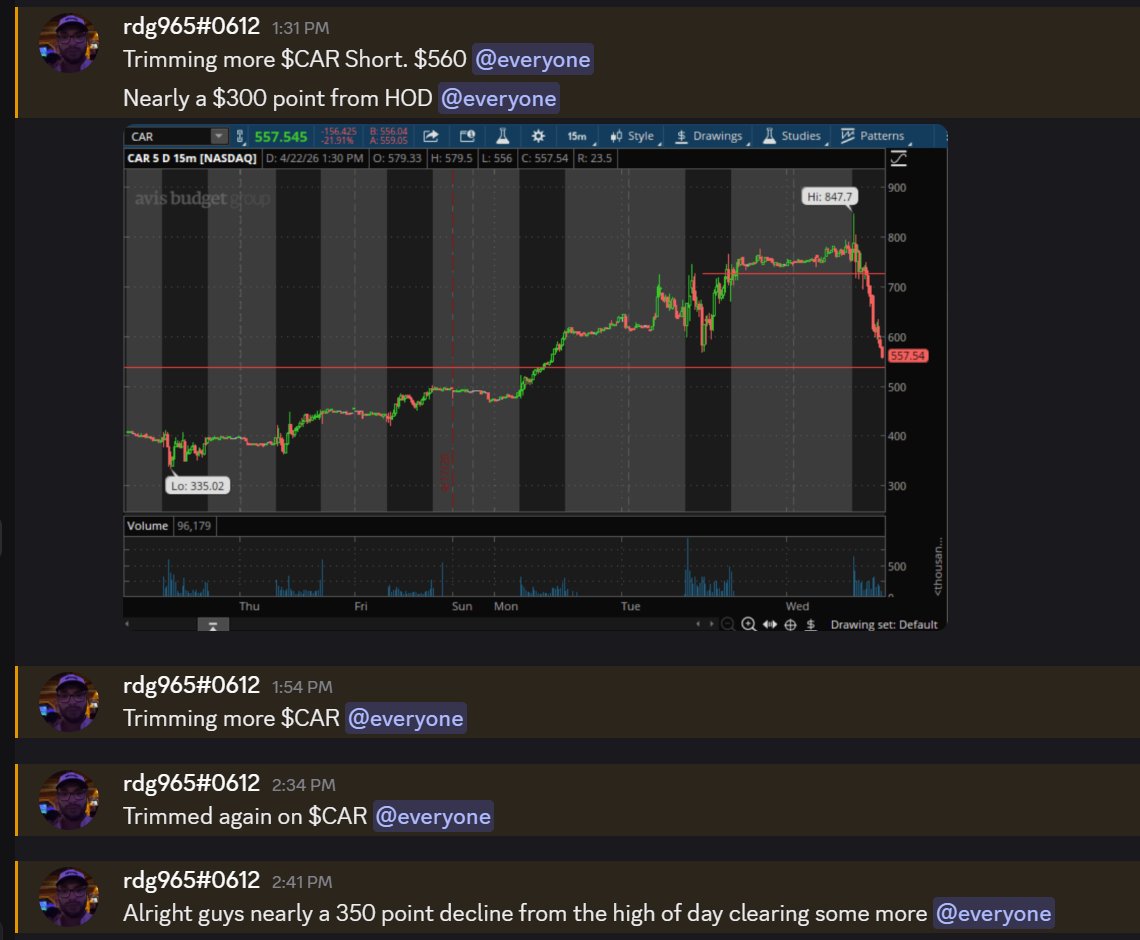
CAR: trimming the crash live in the Discord, April 22, 2026.
When fear of war with Iran sent oil from $85 to $117 in days, we read it as a temporary war premium. The administration's negotiation pattern had been consistent: maximum pressure, then a deal. We scaled from 30 to 115 shares over five days and made $22.50 a share when the premium came out.
In 2025 we shorted silver into a euphoric blowoff top after an extended parabolic run. It was the same behavioral read we use on stocks, applied to a commodity.
What We Won't Short
We don't short a stock just because it looks expensive or the chart looks extended. Plenty of expensive stocks keep going up for years. We need the behavior: acceleration at the end of a long move, a crowd buying on momentum alone, and ideally a structural reason the price can't hold, like the Avis share offering. If those aren't there, we pass.
Common Questions
Isn't short selling dangerous?
Yes. A stock can rise far more than it can fall, so losses on a short are not capped by the price you paid. That is why we start small, add slowly, and set a maximum loss before entering. On CAR the stock moved $170 a share against us and the position was still sized to survive it.
Do you short based on fundamentals?
Usually not. We short behavior: parabolic runs where the last leg is the fastest and the buyers are reacting to the price itself. Micron was a strong business when we shorted it. The trade was about the people buying at $818.
What do I need to short a stock?
A margin account with a broker that allows short selling, and shares available to borrow. On very crowded shorts, like CAR at the peak, brokers can run out of shares to lend.
How long do you hold a short?
Anywhere from minutes to a couple of weeks. Intraday shorts like our QCOM scalp last minutes. Swing shorts like MU and USO ran from five days to about ten.
Sweet Spot Trading is for educational and informational purposes only. Trade ideas are opinions, not financial advice, and past results do not guarantee future returns. Trading, and especially options and short selling, involves substantial risk of loss.